


Showing 44 posts in Boarding.
Review Your Liability Insurance on Insurance Awareness Day
 June 28th is National Insurance Awareness Day. Certainly, people in the equine industry may be aware that they have liability insurance, but they sometimes forget to assess whether they have the right insurance. National Insurance Awareness Day offers an annual reminder to review, understand, and update your insurance policies. Read More ›
Categories: Boarding, Compliance, Insurance, Liability, Workers' Compensation
 Share
Share

Latest Word on “Dangerous Land” Under State Equine Activity Liability Acts
 Courts nationwide have grappled with the meaning of equine activity liability laws – especially their exceptions. Exceptions in the laws are important as they could potentially allow certain lawsuits to proceed. Although all of the equine activity liability acts (referred to as “EALAs”) differ, many share common characteristics. Several include an exception for a “dangerous latent condition of the land.” This article explores how the exception has been faring in the courts. Read More ›
Categories: Boarding, Lawsuit, Liability
Equine Event Liabilities – Plan Ahead
 Your club or association wants to organize a horse show or clinic. These events, your group believes, will boost publicity, increase membership, and generate extra money. Usually the event is a success, leaving happy memories and satisfied participants. But sometimes, things can go wrong, such as: Read More ›
Categories: Boarding, Lawsuit, Liability
Equine Health Maintenance Programs at the Boarding Stable – What’s Best?
 Teenagers, when they learn to drive, are sometimes cautioned that they’re actually driving five cars at once – cars in front of them, behind them, and on either side in addition to the car in which they’re seated – and must watch all of them to protect their safety. In a roughly comparable way, those who board their horses at other peoples’ stables have every incentive to be watchful of the other horses on the property. Knowing that all the horses are current on their de-wormings and vaccinations can be just as important as making sure that your own horse stays on schedule. All it takes is one horse with a contagious illness, such as strangles, to cause disastrous problems throughout the whole barn. Read More ›
Categories: Boarding, Contracts
Contracts Can Save Lives: How Boarding Contracts Can Handle Horse Emergencies
 A boarded horse colics severely and requires emergency surgery, but the boarding stable cannot reach the owner to consent. Days earlier, the owner left for a vacation in a remote place with no phone or internet access. Despite hours of effort, the stable cannot find the horse owner. Finally, with no way of knowing whether the owner will approve costly surgery, the stable directs the veterinarian to euthanize the suffering horse.
A week later, the owner returns from vacation, only to find that her horse is gone. Then, when she submits a claim with her equine insurer, the company denies her insurance claim because the owner violated the insurance policy's condition to give the insurer timely notice of the horse's illness and death.
Although emergencies are a foreseeable part of horse ownership, the rest of this scenario could have been avoided, as this article explains. Read More ›
Categories: Boarding, Contracts, Insurance
ABA Publishes Julie Fershtman’s Newest Book on Equine Law
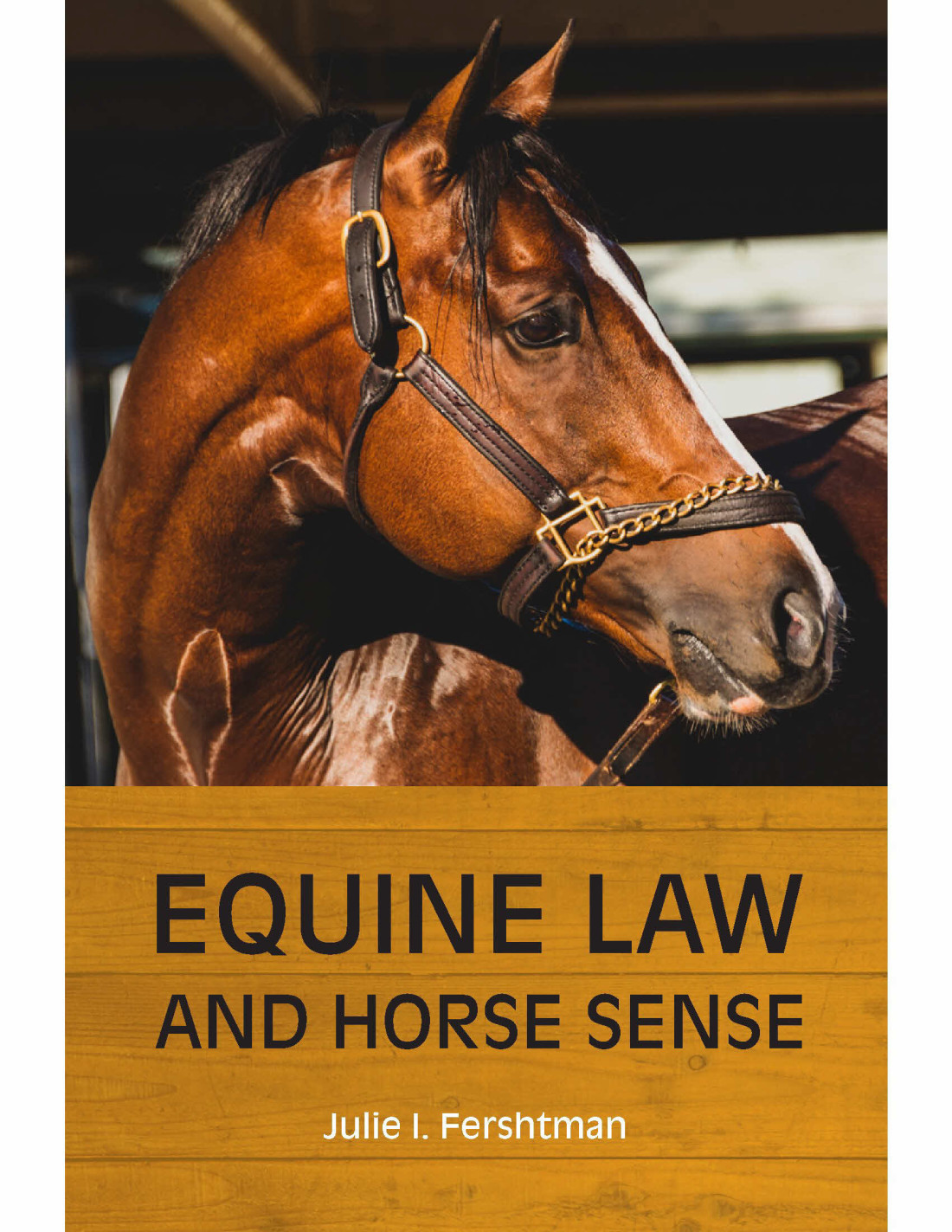 Foster Swift shareholder Julie I. Fershtman’s latest book, Equine Law and Horse Sense, has just been published by the American Bar Association (ABA). Read More ›
Categories: Animal Abuse, Boarding, Breeding, Lawsuit, Liability, Zoning & Land Use
I’m Not a Boarding Stable, BUT …
A backyard horse owner named Jane boards a few horses during the winter. Jane’s facility has box stalls and an indoor arena, making it desirable during the snowy winter months where Jane lives. Jane doesn’t view her activities as a business. She views herself as earning some extra money and helping friends.
What could go wrong? Plenty. Read More ›
Categories: Boarding, Contracts, Insurance, Liability
Communication Can Save Lives and Avoid Horse Boarding Disputes
Never did the stable owner expect to be sued. A horse in his care became injured in the pasture, with a large wound, but the stable owner thought he had it under control. He dressed the wound, gave the horse a penicillin shot using old medication in the barn refrigerator, left the horse in the stall for a few days to rest and recover, and gave the horse only quick checks in the days that followed. There was no need to call a veterinarian, he thought. Several days later, however, the horse’s condition worsened to a very serious point, and by the time a veterinarian was summoned, the horse had to be put down. It turned out that the cut was more severe than the stable owner thought, and the penicillin was unsuitable for the horse. At the very end, a surprised horse owner received the call that the horse was gone. Read More ›
Categories: Boarding
Legal Aspects of Boarding at a Friend's Barn
Cindy and Sam have been long-time friends and once rode together. Now, as Sam recovers from a serious illness, his barn has been empty. He once enjoyed looking out at the horses in his pasture. He approached Cindy with an offer to stable her horses on his property for free, as long as she takes care of her horses at her own expense.
People sometimes enter into arrangements like this, but what are the legalities? What can Cindy and Sam do to protect themselves? Read More ›
Categories: Boarding, Insurance, Liability
Stable Rules: What's on YOUR Wall?
Should your stable have rules? Stable rules list the various policies and regulations governing activities on the property. In developing and posting them, stables try to establish limits for customers and visitors, set expectations, and promote safety. Stables have every incentive to develop, post, use, and update rules. Read More ›
Categories: Boarding, Contracts, Liability



Top 10 Things The Equine Community Needs To Know About Equine Liability Laws
"Julie Fershtman is considered by many to be the nation's leading expert on equine activity liability acts. Her 30-minute presentation for a recent educational webinar on equine activity liability acts for the American Horse Council is available for viewing. Please take a look, here's a link: https://www.youtube.com/watch?v=hCROISSPMJs
Fershtman’s Equine Law Book Wins Fourth National Award
 Julie Fershtman’s latest book, Equine Law and Horse Sense, won its fourth national award on May 31, 2021. It was selected to receive a "Finalist" Medal in the 2021 Next Generation Indie Book Awards.
The 2021 Next Generation Indie Book Awards are presented by Independent Book Publishing Professionals Group, which is the largest International awards program for indie authors and independent publishers. Here’s a link for the complete list of 2021 winners and finalists: https://www.indiebookawards.com/winners.php?year=2021
Fershtman’s Equine Law Book Receives Third National Award
Julie Fershtman’s book, Equine Law & Horse Sense, published by the American Bar Association, has been selected to receive a 2020 NYC Big Book Award in the category of “Reference” books.
The NYC Big Book Awards draws nominations world-wide. This is the third award for Fershtman’s book since its publication last year. Here is a link for more information, and to see the list of winners: https://www.nycbigbookaward.com/2020winners
Information on the book: https://www.amazon.com/gp/product/164105493X/ref=dbs_a_def_rwt_hsch_vapi_taft_p1_i0
Equine Blog Ranked in Feedspot
Foster Swift's Equine Law Blog was ranked #8 in Feedspot.com's "15 Best Equine Law Blogs and Websites".
Categories
- Employee Handbook
- Liability
- Defamation
- Insurance
- Fashion
- Sales/Disputes
- Labor Relations
- Workers' Compensation
- Zoning & Land Use
- News & Events
- Veterinary Malpractice
- Employment
- Lawsuit
- Breeding
- Fraud & Abuse
- Boarding
- Licensing
- Animal Abuse
- Compliance
- Billing/Payment
- News
- Regulatory
- Radio Broadcasts
- Contracts
- Department of Labor
- Did you Know?
Upcoming Speaking Engagements
In 2022, Julie Fershtman is scheduled to be a speaker on equine liability at these conventions:
- American Horse Council Annual Meeting and National Issues Forum, Washington D.C. - June 6, 2022
- National Conference on Equine Law, Lexington, Kentucky – May 4, 2022
- IRMI Agribusiness Conference (“AgriCon”), Sacramento, California – March 8, 2022
- New York State Bar Association Equine Law Symposium (virtual conference) – February 9, 2022
Fershtman’s Equine Law Book Receives Second National Award
Julie Fershtman’s book, Equine Law & Horse Sense, published by the American Bar Association, has been selected to receive a 2020 NYC Big Book Award in the category of “Reference” books.
The NYC Big Book Awards draws nominations world-wide. This is the third award for Fershtman’s book since its publication last year. Here is a link for more information, and to see the list of winners: https://www.nycbigbookaward.com/2020winners
Information on the book: https://www.amazon.com/gp/product/164105493X/ref=dbs_a_def_rwt_hsch_vapi_taft_p1_i0
Honors & Recognitions
Equine lawyer, Julie Fershtman, has received these prestigious equine industry awards from respected equine organizations:
"Excellence in the Advancement of Animal Law Award" - American Bar Association Tort Trial & Insurance Law Section Animal Law Committee
"Distinguished Service Award" - American Youth Horse Council
"Industry Service Award" - Michigan Equine Partnership
"Catalyst Award"- Michigan Horse Council
"Outstanding Achievement Award" - American Riding Instructors Association
"Partner in Safety Award" - American Riding Instructors Association
"Associate Service Award" - United Professional Horseman's Association
"National Partnership in Safety" Award" - Certified Horsemanship Association
Some of our Equine Law Services
Handling breach of contract, fraud/ misrepresentation, commercial code, and other claims involving equine-related transactions including purchases/sales, leases, mare leases/foal transfers, and partnerships.
Litigating a wide variety of equine-related disputes in court or through alternative dispute resolution (arbitration, mediation, facilitation).
Defending equine/farm/equestrian industry professionals, businesses, and associations in personal injury claims and lawsuits.
Drafting and negotiating contracts for boarding, training, sales, waivers/releases, leases, and numerous other equine-related transactions.
Representing and advising insurers on coverage and policy language as well as litigation;
Advising equine industry clubs and associations regarding management, rules, bylaws, disputes, and regulations.
Representing some of the equine industry's top trainers, competitors, stables, and associations.
Counseling industry professionals, stable managers, and individual horse owners.
THE NATION'S MOST SOUGHT-AFTER EQUINE LAW SPEAKER
Did you know Julie Fershtman has spoken at the American Horse Council Annual Meeting, Equine Affaire, US Hunter/Jumper Association Annual Meeting, Midwest Horse Fair, Equitana USA, US Dressage Federation Annual Meeting, North American Riding for the Handicapped (now PATH International) Annual Meeting, American Paint Horse Association Annual Meeting, US Pony Clubs, Inc.'s Annual Meeting, All-American Quarter Horse Congress, American Youth Horse Council Annual Meeting, American Riding Instructors Association Annual Meeting, CHA Annual Meeting, and numerous others? Consider signing her up for your convention. Contact Julie directly.
Follow Us on Twitter!
Follow us for updates regarding news, cases, disputes, and issues regarding Equine Law. @horselawyers